
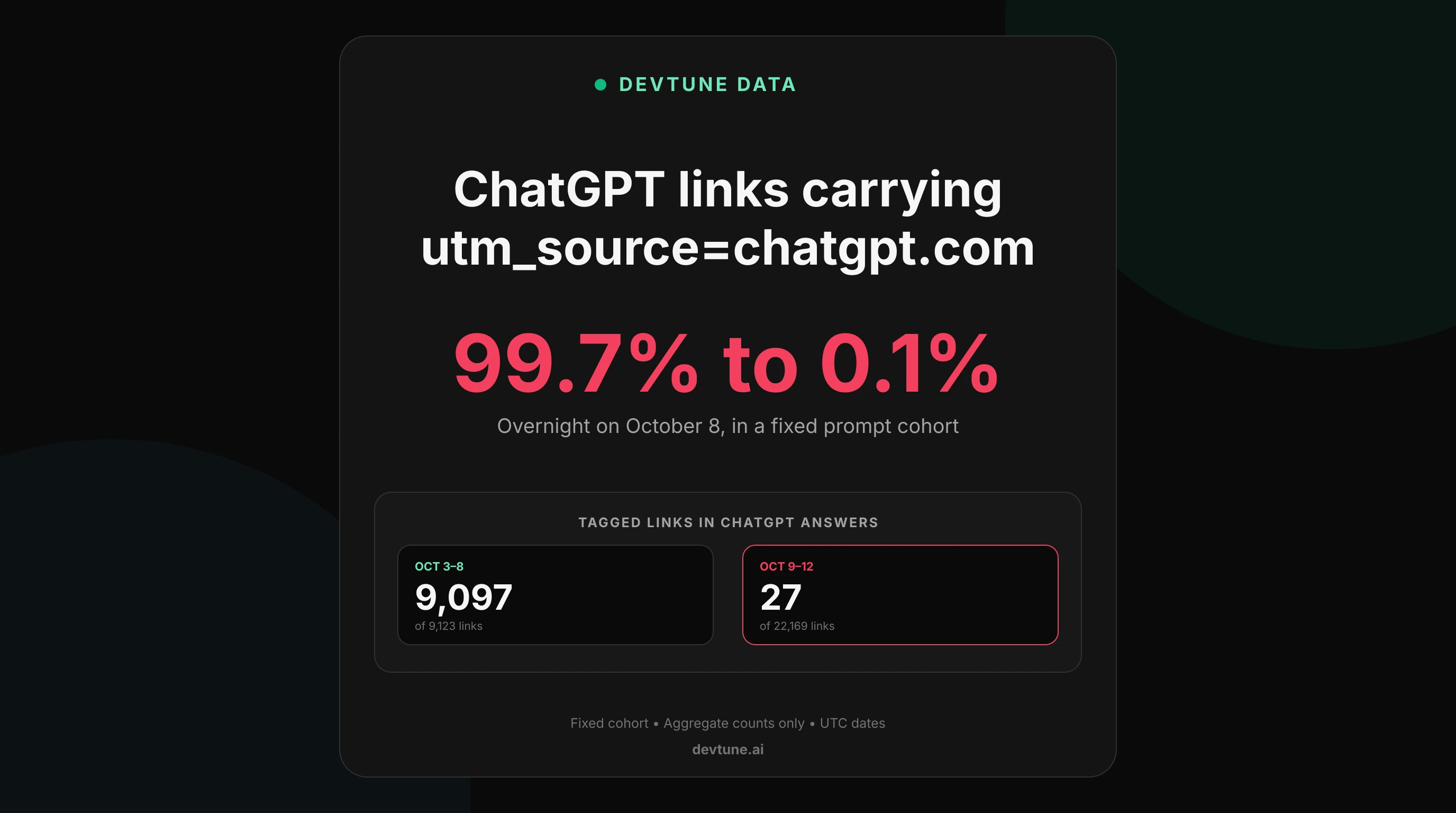
Links in ChatGPT answers stopped carrying utm_source=chatgpt.com overnight on October 8, 2026.
Across a fixed cohort of 874 prompts tracked in both comparison windows, 9,097 of 9,123 links in ChatGPT answers carried the tag from October 3 to 8. That is 99.7%. From October 9 to 12, 27 of 22,169 did, or 0.1%.
Every prompt in the comparison was tracked in both windows. That holds the prompt set constant while the answers change.
The break happened between 19:00 and 24:00 UTC on October 8. In the last batch before it, every answer with a link had a tagged link. In the first batch after it, none did.
These numbers come from ChatGPT answers captured by DevTune's production prompt tracking and from AI traffic recorded by DevTune's sensors. The analysis contains no customer, project, account, prompt text, brand, topic or individual URL.
DevTune also publishes public AI search benchmarks for developer tools, with visibility and citation data broken down by category, brand and platform.
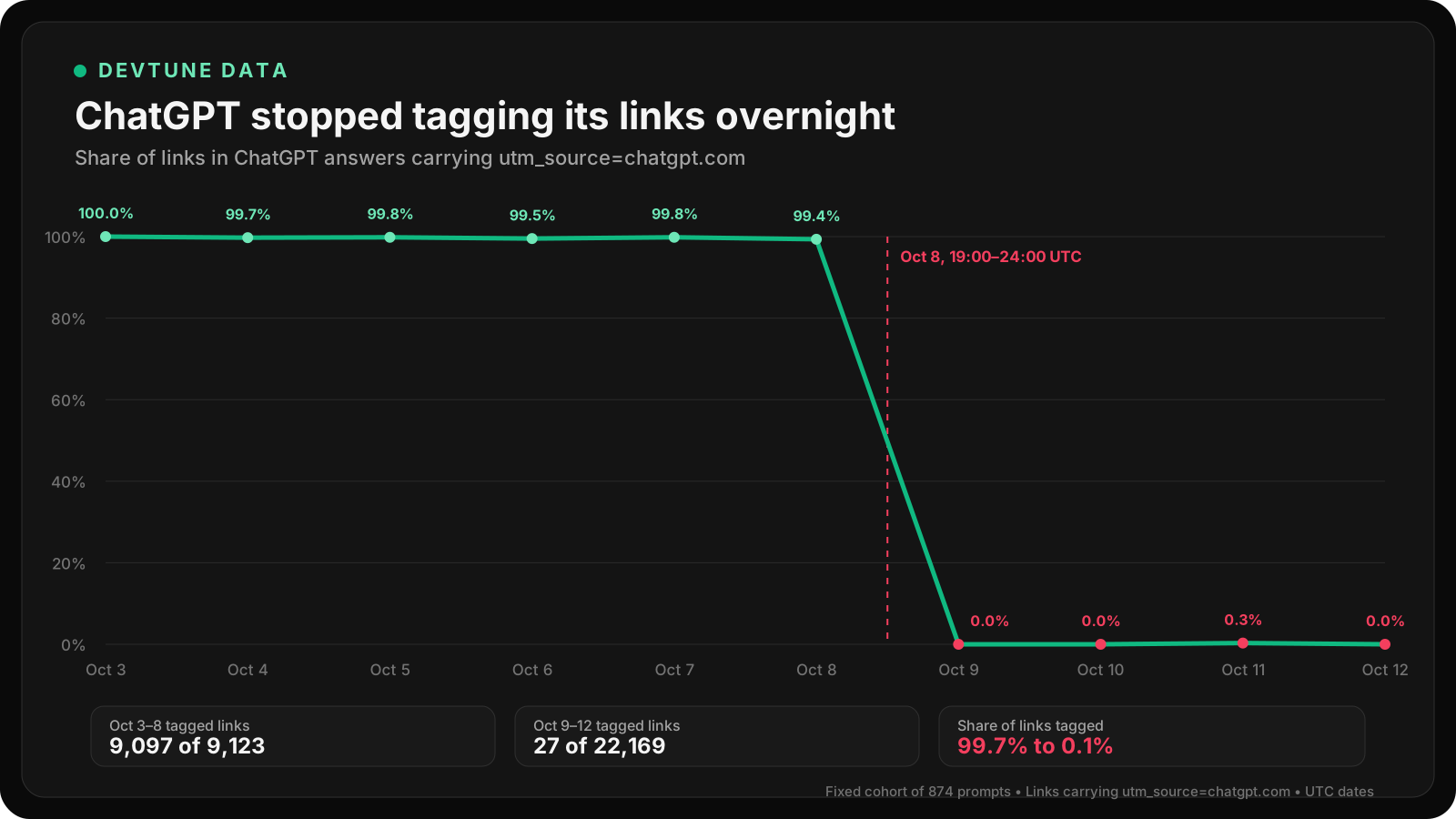
Daily share of tagged links for a fixed prompt cohort. Dates are UTC.
The tag disappeared in one step
There was no gradual decline. The tagged share held between 99.4% and 100% on each of the six days from October 3 to 8. It was 0.0% on October 9, 10 and 12, and 0.3% on October 11.
The answer-level view is starker. From October 3 to 8, 2,629 of 2,629 answers that contained a link had at least one tagged link. From October 9 to 12, 8 of 1,805 did.
Those eight answers all came on October 11, and all 27 of their tagged links sat in a source list beneath the answer. None of the 22,142 links written into the answer text carried the tag.
Search Engine Journal reported that ChatGPT referral sessions fell from October 9, a day after a newer model reached ChatGPT's free tiers. The timing matches. We can date the break to a five-hour window. We cannot see which change inside ChatGPT caused it.
The answers changed shape at the same time
Before the break, ChatGPT answers in the cohort listed their sources beneath the text. After it, the links moved into the answer itself.
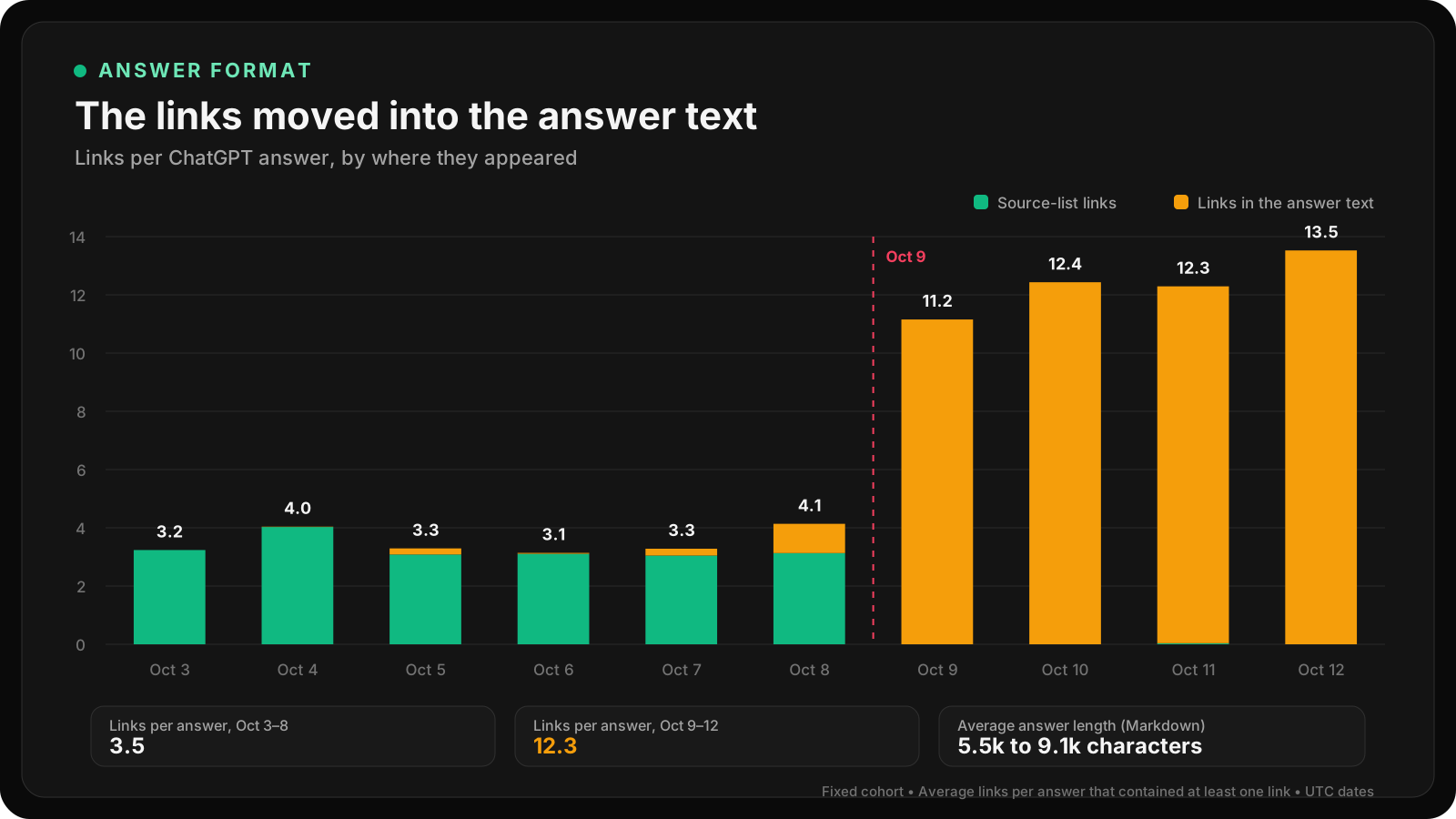
Average links per answer that contained at least one link, split by where the link appeared. Fixed prompt cohort, UTC dates.
Answers with links carried 3.5 links on average from October 3 to 8 and 12.3 from October 9 to 12. Average answer length, counted in Markdown characters with link URLs included, rose from about 5,500 to about 9,100.
The new format arrived before the tags left. Links written into the answer text first appeared in numbers on October 5 and grew on October 7 and 8, and 637 of 662 of them carried the tag from October 3 to 8. On October 8 alone, 113 answers had links in their text and 402 of those 412 links were tagged.
So the change of format alone did not remove the tag. For a few days, ChatGPT used the new format and still tagged the links. The tags disappeared later, between 19:00 and 24:00 UTC on October 8.
ChatGPT kept fetching pages
A missing tag changes what analytics can credit. It does not change whether ChatGPT reads a site.
DevTune's server-side sensors record ChatGPT-User requests. These are the fetches ChatGPT makes when it retrieves a page to answer a question. They do not depend on a tag, a referrer or a browser.
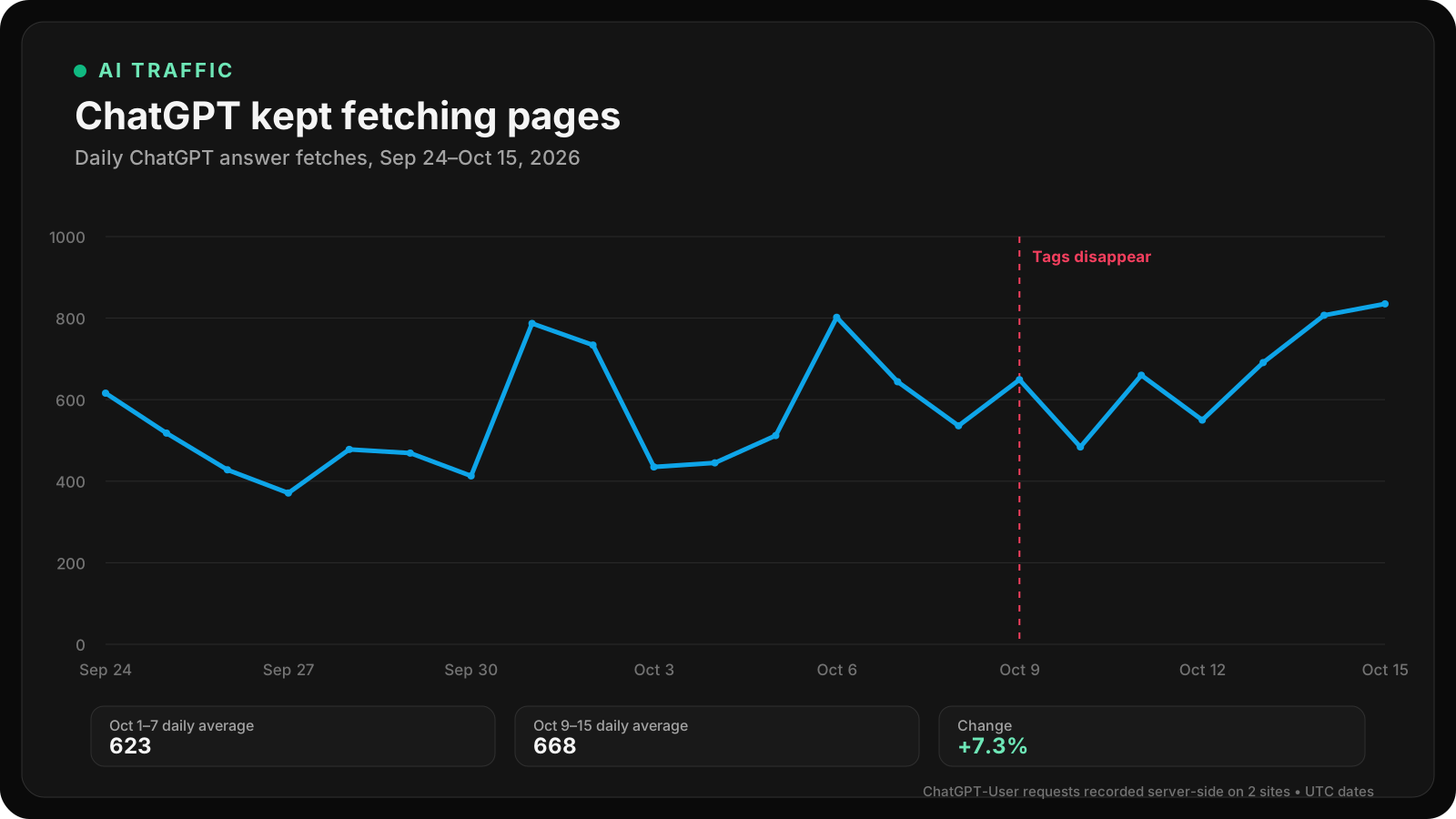
ChatGPT answer fetches recorded server-side. The two sites are the ones where DevTune's Cloudflare or edge sensor ran throughout the period.
On the two sites where those sensors ran throughout, answer fetches averaged 623 a day from October 1 to 7 and 668 a day from October 9 to 15, a 7.3% rise.
That is a small sample, and it is evidence about retrieval, not clicks. But it points the same way as the link data. ChatGPT went on reading these pages after it stopped labelling the links it sent people through.
Most ChatGPT visits carried only the tag
The tag mattered because, for most visits, nothing else identified ChatGPT as the source.
Across three sites running DevTune's browser snippet, we recorded 148 visits attributed to ChatGPT from September 17 to October 15:
| Signal on the visit | Visits | Share |
|---|---|---|
| Tag, no referrer | 92 | 62.2% |
| Tag and a ChatGPT referrer | 48 | 32.4% |
| ChatGPT referrer, no tag | 8 | 5.4% |
140 of 148 visits carried utm_source=chatgpt.com. Only 56 carried a ChatGPT referrer. Remove the tag and 92 visits, 62.2%, have nothing left to identify them. Analytics tools file those as direct traffic.
What this means for teams tracking AI referrals
A falling ChatGPT referral line from October 9 is not, on its own, evidence that fewer people reached your site.
Annotate the break before reading the trend
Mark October 8 to 15 in every report that counts ChatGPT referrals, sessions or conversions. Any week-on-week comparison that crosses October 9 is measuring a change in labelling as well as a change in visits.
Search Engine Journal reported that OpenAI began rolling out a fix on October 15. A fix does not relabel visits that were already counted as direct.
Check direct traffic page by page
If ChatGPT sessions fell while direct sessions rose on the same pages, the visits were probably relabelled. Pages that ChatGPT cites often are where to look first.
A sitewide direct total is too large to show the shift. Compare page by page.
Measure demand without the tag
Referral counts depend on a tag that ChatGPT controls and can drop overnight. Citations in tracked answers and server-side answer fetches do not depend on it.
When the referral line moves, check whether citations and fetches moved with it. If they held, the problem is most likely attribution. If they fell too, it is most likely demand.
Methodology
This analysis uses aggregate DevTune production data. Dates and times are UTC.
For the link comparison, we selected a fixed cohort of 874 ChatGPT prompts with at least one successful execution in both the October 3 to 8 window and the October 9 to 12 window. The cohort produced 2,832 answers in the first window and 1,806 in the second.
For each answer, we counted two kinds of link: links in the source list returned with the answer, and links written into the answer text. A link counts as tagged when its URL contains utm_source=chatgpt.com. Tagged share is:
tagged links ÷ all links × 100
Window values are totals across the window, not averages of daily shares. Links per answer counts only answers that contained at least one link. Answer length is the character count of the answer as returned in Markdown, including link URLs, averaged across answers.
The break window comes from all successful ChatGPT executions captured on October 8 and 9, not only the cohort. The last batch with tagged links ran at 19:00 UTC on October 8; 24 of its 25 answers contained a link, and all 24 had a tagged link. The next batch ran at 00:00 UTC on October 9; all 10 of its answers contained a link, and none was tagged. No executions ran in between.
Answer fetches are requests whose user agent contains ChatGPT-User, recorded by DevTune's Cloudflare log integration or edge middleware. Two sites had one of those sensors running from September 24 to October 15. The comparison averages October 1 to 7 against October 9 to 15, leaving out October 8.
The referral table uses visits recorded by DevTune's browser snippet and attributed to ChatGPT by tag or referrer.
All published charts and tables contain aggregate counts only. They disclose no prompt text, customer identity, project, account, tracked brand, topic or URL.
This cohort represents prompts tracked by DevTune. It does not represent every query submitted to ChatGPT, every ChatGPT surface or every user plan.
We can see what broke, not why
DevTune's data shows ChatGPT's tagged links falling from 99.7% to 0.1% in a single overnight step on October 8, as the answers moved their links into the text.
Our captures record the answer as returned. They do not show every panel a user can open, and they do not include the ChatGPT apps. Links in other parts of the interface may have kept their tags. We cannot say whether the fix reached the links in our sample, because this comparison ends on October 12.
The result itself is clear. For at least four days, the links ChatGPT wrote into its answers carried no tag, and on the two sites where we record its requests, ChatGPT went on fetching pages.
Referral data tells you what your analytics could label. Pair it with measures the platform cannot switch off overnight.