How DevTune measures AI search visibility for dev tools
How DevTune selects prompts, samples AI answers, shows uncertainty and missing data, and measures citations, AI traffic and results after changes ship.

An AI assistant can recommend your product in one answer and leave it out of the next. Before you decide what to fix, you need to know how often that happens, on which questions and platforms, and from how many answers.
DevTune runs your prompts on a schedule, records the answers, shows the uncertainty around each rate and pairs it with what AI systems fetch from your site. That evidence drives the fixes we draft for your approval and the before/after comparison once you ship.
Prompts
Our State of AI Search for Dev Tools uses the same tracking data. The 2026 edition covers 43 categories, 1,075 test scenarios and 54,747 recorded answers from a frozen 90-day window, 2 April to 30 June 2026. Those answers produced 126,814 citation records, which the report defines like this:
A citation record is one source link in one AI answer.
An answer can cite several pages, so a citation count isn't a count of answers, buyers or recommendations. The report benchmarks how five platforms answered questions we chose, asked weekly. It isn't a log of what buyers asked, a search-volume estimate or a live market ranking.
For your project, choose prompts around the decisions your buyers face, such as exploring a category, checking an integration or planning a migration, and group them into topics. Generated prompts avoid company and product names by default and vary buyer context and phrasing. They're simulated probes, not questions customers asked, so improve them with language from sales calls, support conversations and customer research. Prompt selection.
Keep questions that name your product in separate topics from category questions. A high mention rate on prompts that supply your name doesn't show whether AI would name you unprompted. Changing questions, platforms or tracked competitors also changes what an aggregate measures, so check for that before reading a movement.
Sample size and uncertainty
The standard tracking platforms run daily. Enterprise Claude and Grok checks run weekly unless the contract specifies daily checks. The report's weekly cadence is separate from your project's schedule. Platform coverage and cadence.
Prompt tables, the Home Visibility tile, the Visibility overview and shared reports show a Presence Range: a 90% Wilson score interval calculated from citation-eligible answer counts. Below ten observations, the range is labelled directional. With no eligible observations, there's no range to show. Presence Ranges.
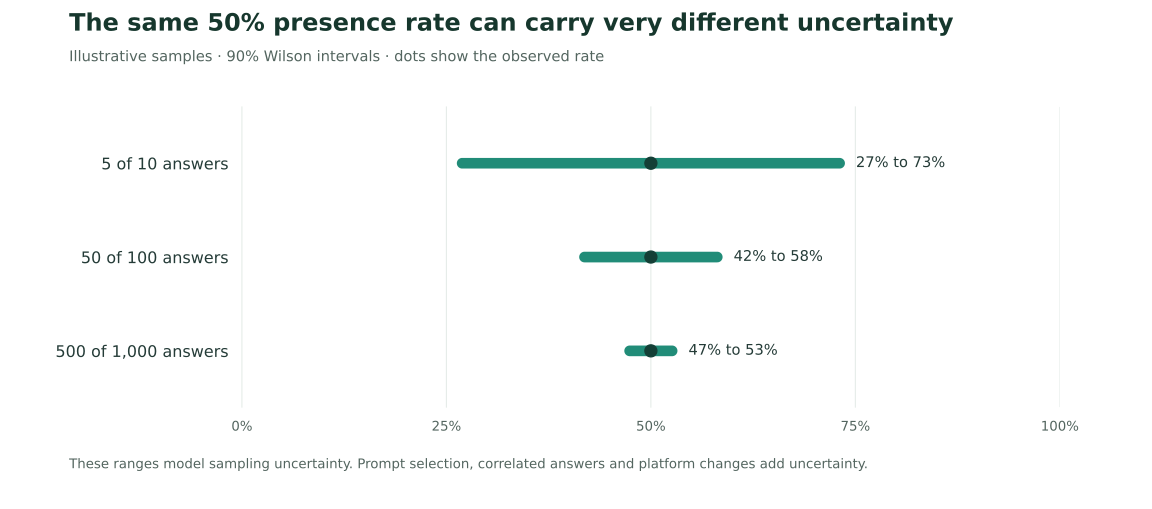
Calculated examples, not customer results.
The range matters most when you compare two periods. Say a prompt's citation presence was 40% last month and 55% this month:
| Eligible answers per month | 40% last month | 55% this month |
|---|---|---|
| 20 | 24% to 58% | 37% to 72% |
| 100 | 32% to 48% | 47% to 63% |
With 20 answers, the ranges overlap across most of their width and the rise could be chance. With 100, they barely touch. The number of answers behind each period decides whether a movement can be read at all.
Calculated 90% Wilson ranges, not customer results.
The range models sampling uncertainty and nothing else. It doesn't correct an unrepresentative question set, make repeated answers independent or account for every platform change. How much another AI answer is worth measures how alike repeated answers are, and why adding prompts narrows a range faster than repeating them. A small movement needs more scrutiny than a large, sustained change across comparable observations.
Platforms and metrics
Platforms cite differently. In the frozen report, ChatGPT Search produced 3.42 citation records per answer execution and Perplexity 1.56. At that ChatGPT Search rate, 400 citations could come from about 120 answers. Those figures describe that period and question set, not either platform permanently.
A blended number can move because one platform supplied more observations, so the Visibility dashboard, Positioning and Accuracy can each be filtered to one platform, Accuracy breaks its results out by platform, and each prompt's answers and sources are listed per platform. Daily trend lines leave out weekly-only platforms, so one weekly check doesn't look like a spike followed by six empty days. Whole-window totals still include them.
| Metric | What it tells you |
|---|---|
| Brand mention | The answer contains your brand terms |
| Citation presence | The answer cites at least one of your tracked URLs |
| Share of voice | Your citations divided by your citations plus configured competitors' citations |
| Recommendation | The answer presents a product as an option to use |
A source can be cited without its publisher being named, and a brand can be named without a link. An answer can cite your docs and still recommend a competitor, so Recommendation is counted separately. Share of voice counts only the competitors you configured. Reading the answer explains what the counts can't. Metric definitions.
Coverage
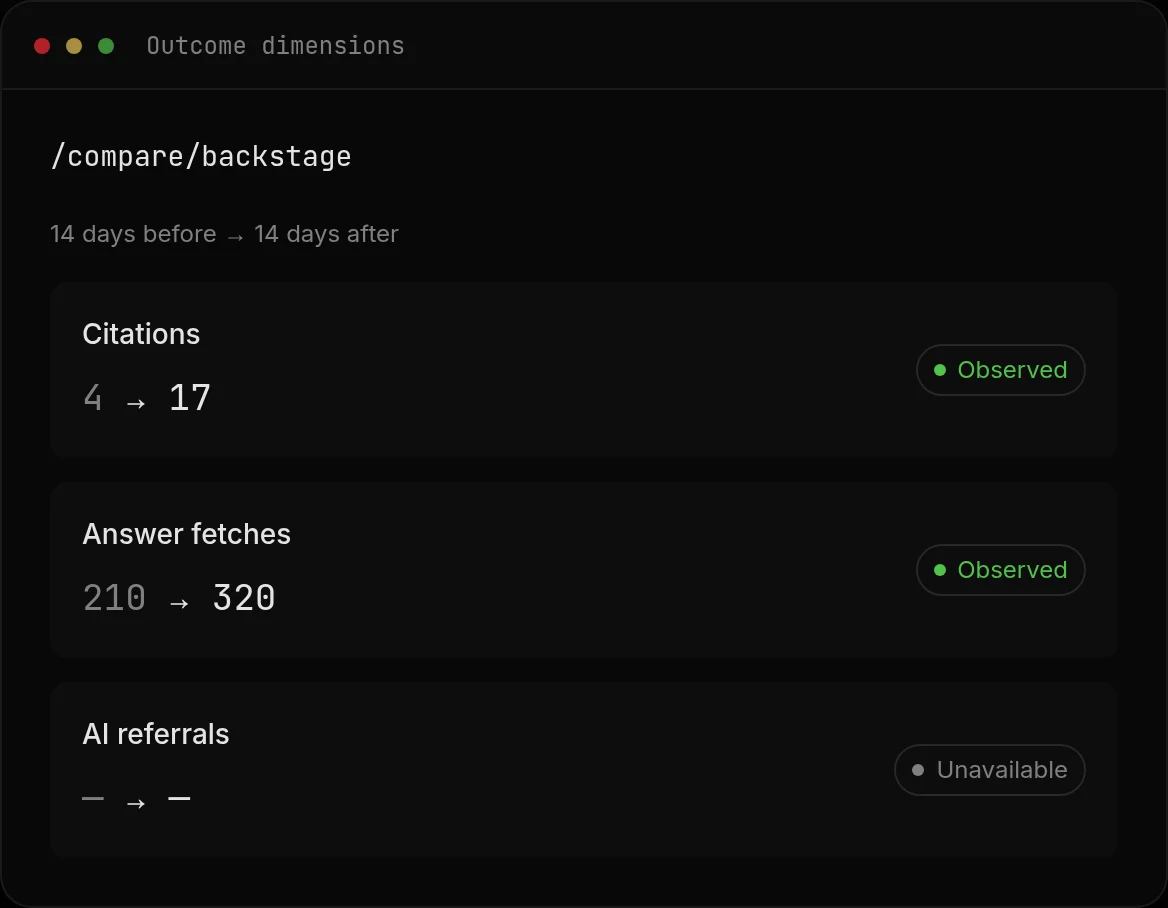
A zero only counts when it was measured. If an answer comes back without citation evidence, or no sensor covered the window, DevTune marks that measure Unavailable instead of recording a miss. If a sensor covered only part of the window, its measure is shown as Directional. Coverage sits beside the results, and citation presence is calculated from answers with usable citation evidence, so a gap in collection can't pull your rate down.
AI Traffic
AI Traffic counts crawls, answer fetches, referrals and selected conversion events separately. Cloudflare or edge middleware supplies server-side requests, including requests for missing pages. GA4 or PostHog supplies referral sessions and conversion events. Search Console adds classic-search performance. AI Traffic.
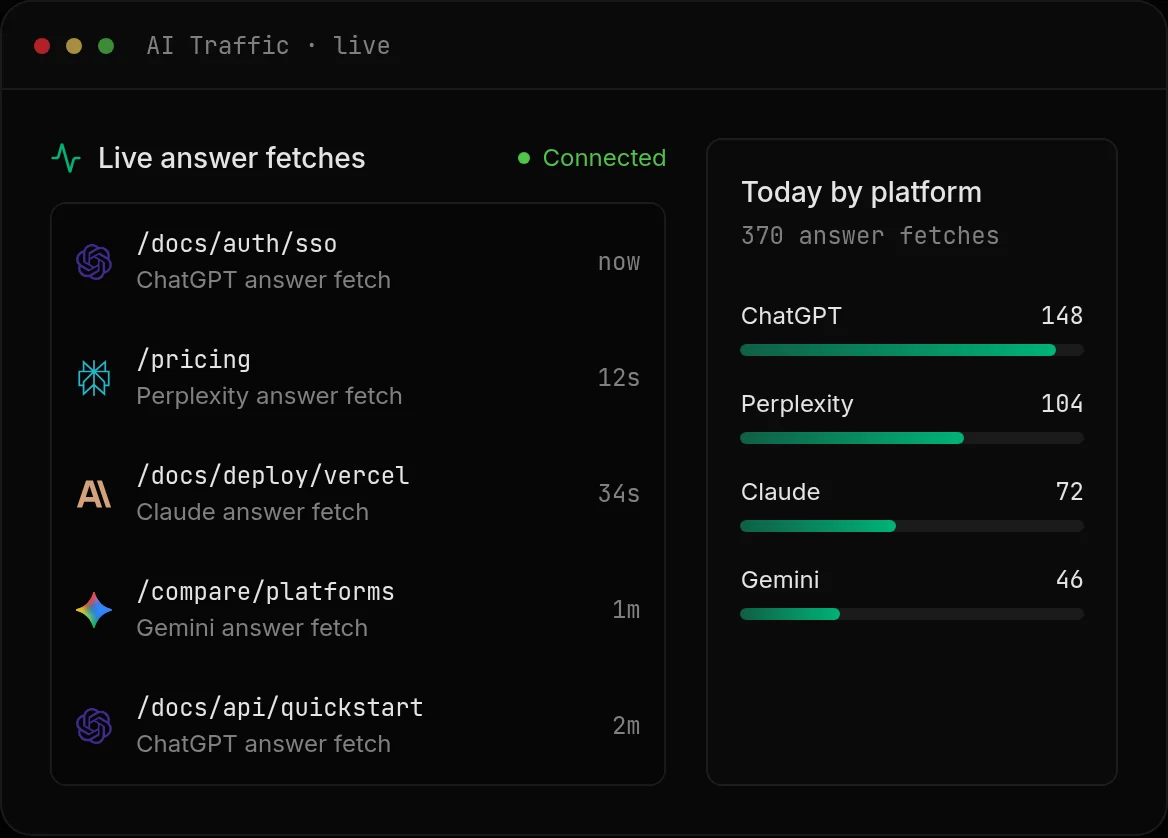
A browser snippet can't see a server-side fetch that never runs JavaScript. If a server-side sensor covered the full period and a page has no answer fetches, that zero is observed. Without that coverage, an empty chart can't show that AI systems never requested the page, and connecting a sensor today won't recover last month's requests. A citation doesn't establish a visit either, and these measures don't trace a path from one answer to a purchase. Sensor capabilities and coverage.
Accuracy
Accuracy checks sample up to three qualifying answers per prompt, platform and week, and compare claims about your product with pages we've crawled on your site. Coverage shows which answers were checked, which are waiting and which couldn't be checked.
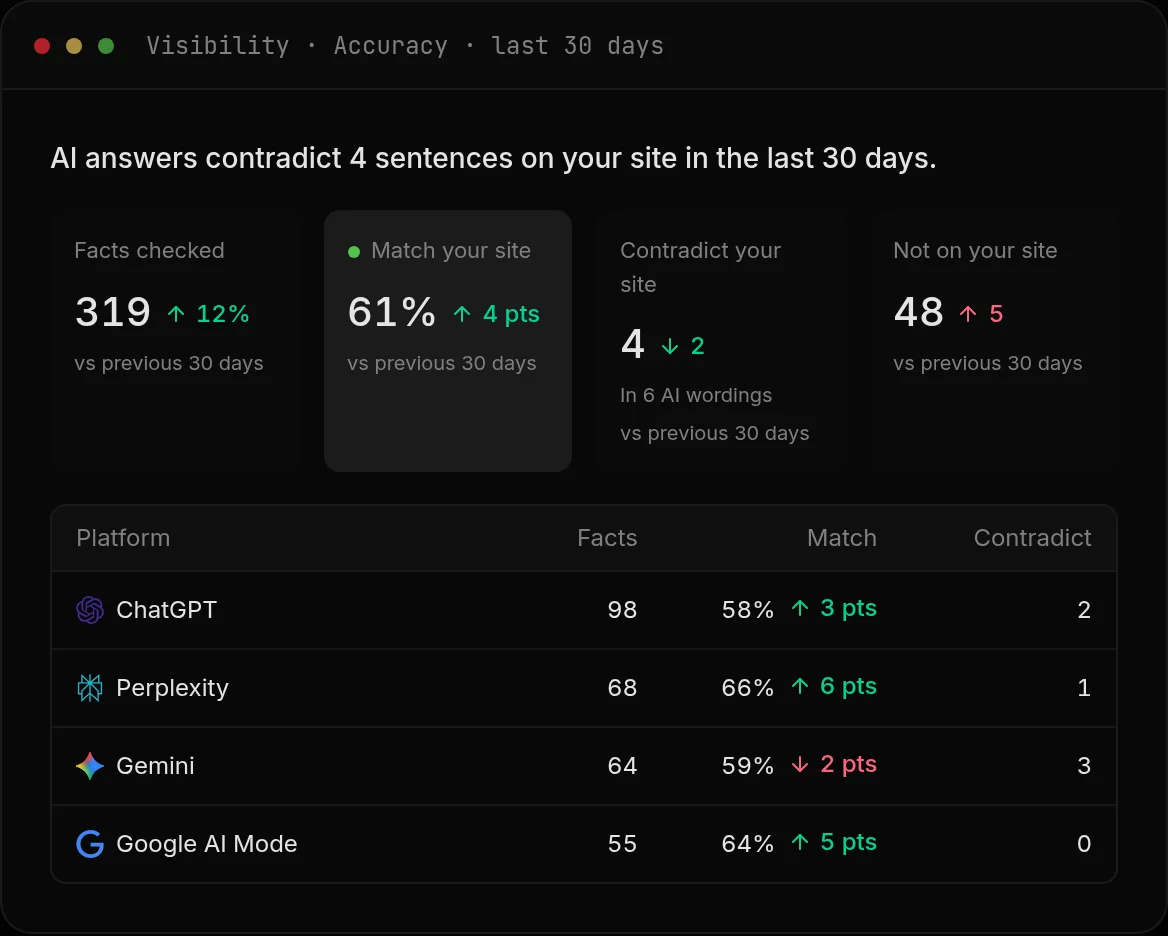
A fact missing from your site stays separate from a contradiction. Comparisons that span a sampling-method change are labelled as a method change, not shown as a trend. Accuracy methodology.
Actions and Results
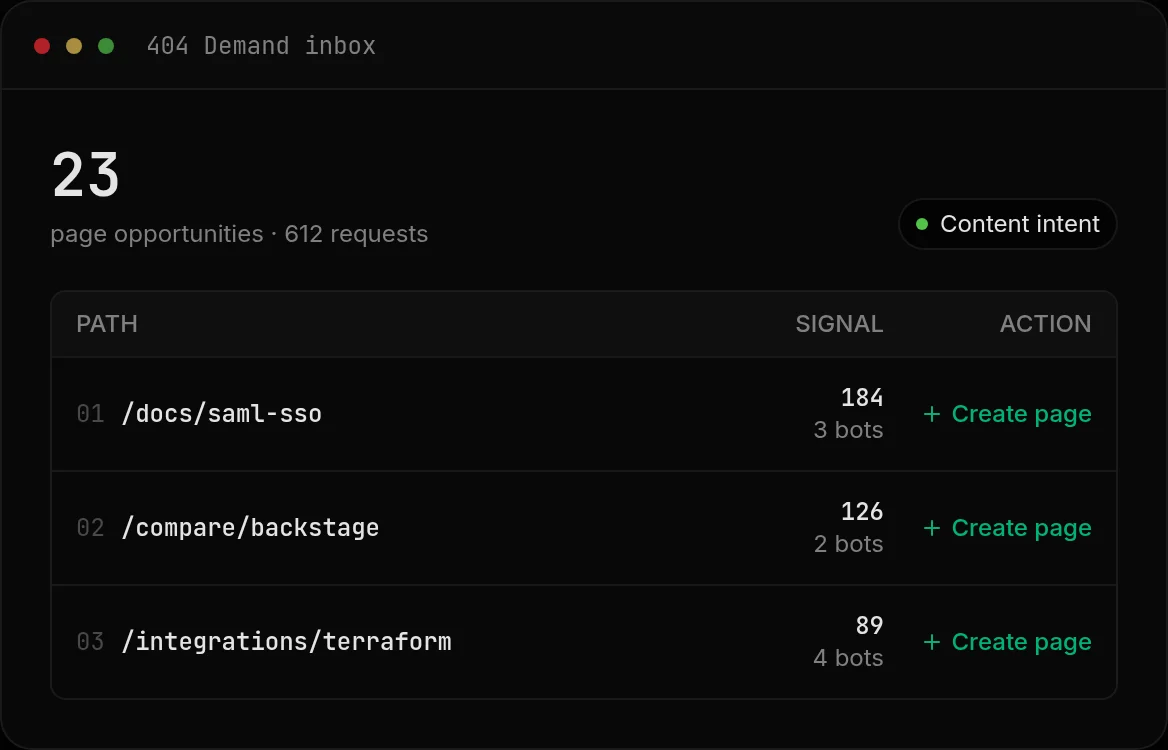
The evidence points to different fixes. Repeated requests for a missing page create 404 demand. A cited comparison page can carry an outdated claim. A docs page can attract answer fetches while the relevant questions still cite competitors. DevTune carries that evidence into Actions, where agents prepare a brief or draft for you to approve.
When an action goes live, Results compares the 14 days after the change with the 14 days before. A citation or answer-fetch change counts as movement only when it passes the chance threshold, moves the rate by at least 20%, and has at least three observations in the higher window spread across at least three days. Citation comparisons account for how many probe answers each window contained. The rule applies to rises and falls alike.
Newly closed windows use method v2 and require full coverage before a metric can conclude. Citation comparisons use the same live prompts and platforms in both windows. Fetch comparisons use sensor-covered days. The chance test allows for variation in daily counts. Previously closed windows keep their v1 result.
A result reads improved, mixed, no clear change, declined, still measuring or unmeasured, and lists other completed actions on the same page in the window. It shows what moved, not what caused it: platform updates, other publications and changes elsewhere on the site can contribute. Results methodology.
Probe answers show whether AI platforms pick up a page for the questions you track. Business impact shows in AI Traffic: referrals from AI answers and the conversions they lead to. Read the 14-day window for direction, then keep watching referrals and conversions over the following months.
Reporting the numbers
When you report AI visibility, give the range and the number of answers behind it, not just the rate. Put citation and mention changes beside AI referrals and conversions, so a rise in citations isn't read as a rise in buyers.
Agent Picks
Agent Picks gives coding agents such as Claude Code and Codex a request in a fresh project, then records which tools they choose from the resulting code and answer. Paid tests repeat each environment, request, agent and model combination, and report pick rates, install rates, completed-run counts and 90% Wilson likely ranges. Prompt Presence Ranges use 90%.
A recorded pick or install doesn't show the integration works. Failed runs, incomplete coverage and outcomes we couldn't classify stay visible. Agent Picks measurement.
API and MCP
Your own tools and agents can read the same measurement data through the API and MCP, including coverage and unavailable states. API and MCP.
Start with the State of AI Search for Dev Tools for category patterns. Then measure your own product against buyer-style questions you choose, on the platforms your buyers use.