How coding agents choose tools
How coding agents move from a plain request to an installed tool, what measured run trails show across six public Agent Picks boards, and every way a tool ends up not picked with the fixes and timelines reported by three models.
A pick test gives a coding agent a test app and a plain request such as "add authentication" or "send a welcome email" that names no vendor. The agent then chooses a tool, installs a package or writes code directly. This guide covers how agents make that choice, what run trails show, every way a tool is not picked, and what a vendor can change and how soon it can take effect.
This is part of what the industry calls agent experience (AX). The aim is a tool that agents and the people they work for pick, succeed with and stay with. This guide covers pick in depth and touches succeed, where an agent tries a tool and it fails. It does not cover stay.
This guide rests on two kinds of evidence. The measured kind is the run trail: what agents searched, fetched, installed and ran across 4,376 completed runs. A trail never records why. For the why, we asked three coding models the same question about how they choose: Claude Opus 5.5 in Claude Code, Gemini 4 Neon in Antigravity and GPT 6.1 Sol in Codex. Their answers are their own accounts, so each cause below names the model that reports it, and every number comes from the trails.
All three ran at high effort and answered blind: each was given only the question and made no tool calls; none saw the measured numbers or another model's answer. From here on, this guide uses a short name for each model in its agent:
- Opus: Claude Opus 5.5 in Claude Code
- Neon: Gemini 4 Neon in Antigravity
- Sol: GPT 6.1 Sol in Codex
How an agent works
All three describe a loop that starts inside the repository rather than with a market comparison. Where the three diverge is in how often they search, how quickly they switch on errors, which signals they weigh, and when they accept an unverified integration.
- Start from the repository and the request, not the market. Opus reads the package manifest, lockfile, existing imports,
.env.example, config files, README and rules files first, says that usually decides the pick, and notes that a provider key name in.env.exampleis close to an instruction. Neon inspects dependency manifests, lockfiles, framework configs, environment variable examples, existing database or ORM files and agent instruction, skills or rules files, which it says eliminates most vendors before it considers alternatives. Sol treats installed dependencies, environment variable names, database schemas and existing integrations as strong clues, and notes that it infers requirements from the test app (such as prototype, static, serverless or enterprise context) and that those inferences can be wrong. - Prefer what is already in the test app over adding a new vendor. Opus says an existing dependency or built-in stack option wins because adding a second vendor needs a reason that a plain request does not give. Neon prefers a built-in capability already present in the test app rather than introducing another vendor and more glue code. Sol says it does not automatically treat a plain request as a procurement decision; a new vendor must justify another dependency, account or operational surface.
- Fall back on training priors before searching. All three report starting from existing knowledge rather than running a full vendor comparison, though they describe their search habits and confidence differently. Opus says that with no signal in the repo it falls back on training defaults held with varying confidence by category (very confident in payments, fairly confident in transactional email for TypeScript web apps, and genuinely unsure how its split falls in authentication when no auth is already present); for common jobs it mostly does not search the web, searching when unsure, on an unfamiliar stack, when the request names something unknown, or when an install or API call fails. Neon says it rarely runs a discovery search in well-trodden categories unless the starter stack is unusual, the framework version looks newer than its comfort zone, or the category feels fragmented or fast-moving; it states explicitly that it is unsure of the exact probability or threshold that triggers a search. Sol says it proceeds directly when it believes it can implement the job, and when it does search, it often stops at the first sufficient option rather than comparing providers for a global optimum; it notes it cannot quantify that effect without experiments.
- Pick what can be finished and checked alone. All three avoid paths that require accounts, logins, payment cards or external provisioning they cannot complete. Opus runs the build, typecheck and tests to check its work, says anything that stops the app building or running without credentials pushes it toward another option or a mock, and turns dashboard steps into a placeholder environment variable and a note. Neon optimizes for code that installs, builds and passes checks inside a headless sandbox. Sol adds a nuance: depending on the request, stopping before an unauthorized action or leaving an explicitly unverified integration with a clear human handoff can be the right result rather than switching vendors.
- Local libraries, abstractions and direct code compete with managed vendors. Opus says that for authentication especially, a library running locally with no signup beats a hosted service because it can wire it up and confirm it works in-run, and that when unsure which vendor is meant it sometimes writes a generic provider abstraction with a local transport and a note to configure a provider. Neon reports that it frequently chooses a self-contained open-source library or standard-library approach over a managed vendor because it runs end to end locally with zero credentials and passing tests. Sol implements directly when a few lines of application code seem sufficient, while noting that it can underestimate production complexity (an agent error rather than proof a vendor lacks value).
- Lookups often confirm a choice already made. Opus and Neon both say that when they search or fetch documentation, it is usually after choosing a tool to check current API signatures or versions rather than to compare vendors. Sol emphasizes searching framework-specific implementation questions rather than brand names, and checking primary documentation to confirm consequential details from third-party leads.
- Switch or work around when a vendor step fails. All three report abandoning a tool mid-run when setup or verification breaks, with differences in how fast they pivot. Opus tries a couple of fixes on install, peer-dependency or type errors before switching or downgrading, usually fixes deprecated-API errors (giving up if errors are opaque or docs fail to load), and mocks, abstracts away or switches vendors when missing keys break builds or tests. Neon pivots after a quick retry on install failures, and on compile errors often inspects the package's README and
.d.tsfiles locally to self-correct, switching to an incumbent only when those files are too cryptic to recover from. Sol distinguishes early exploratory installs, which it may remove if the final code uses something else, from an implementation already wired into code, config and tests, where switching creates extra work and later evidence must justify the change. - Context beats memory. All three agree that explicit local context outranks model recall: instruction or rules files (all three), installed packages (all three), MCP servers and agent skills (Opus, Neon), starter templates (all three) and retrieved documentation (Sol) override generic priors. Opus adds that a rules file naming a provider overrides its own preference and an installed MCP server or skill biases it strongly. Sol adds two hard limits: changing a website does not update a shipped model's weights, and a completed pick test does not, by itself, teach the model to choose differently next time.
- Picks vary from run to run. All three report run-to-run variation. Opus says the same prompt can produce different picks and readers should expect a distribution rather than a fixed answer. Neon notes that near-ties in weights can swing on minor wording shifts, subtle repo cues or sampling randomness. Sol notes that generation and tool results can vary under identical conditions.
Opus also lists signals it does not weigh much as far as it can tell: pricing details unless asked (though it skips a vendor with no free tier it knows of, as Neon does; Sol also flags unclear billable units and overages), registry download counts (which it rarely checks, whereas Neon flags very low downloads on an unfamiliar unscoped package), marketing claims such as "built for AI agents", and vendor comparison pages (which it weights less than framework docs and neutral sources, though it cannot measure by how much).
All three models label their accounts self-report. Opus states that it cannot see its own pick distribution, notes that some reasons may be explanations constructed after the fact, and says that if pick-test logs disagree with its account, readers should trust the logs. Neon states that it cannot inspect its own weights, pretraining corpus, cutoff details, post-training reward functions or how a harness's search backend ranks snippets, and cannot reliably predict how small wording shifts swing close choices. Sol states that it cannot inspect its training examples, measure the strength of a vendor association in its weights, reliably explain why one brand came first, or infer the probability of a future pick from its own explanation.
What the trail shows
The measured figures below come from the latest edition of DevTune's six public Agent Picks boards (published at /leaderboards), queried on 2026-11-22, covering 4,376 completed runs. Of those 4,376 completed runs, 2,887 runs installed a package.
| Measure | Result | Definition and caveat |
|---|---|---|
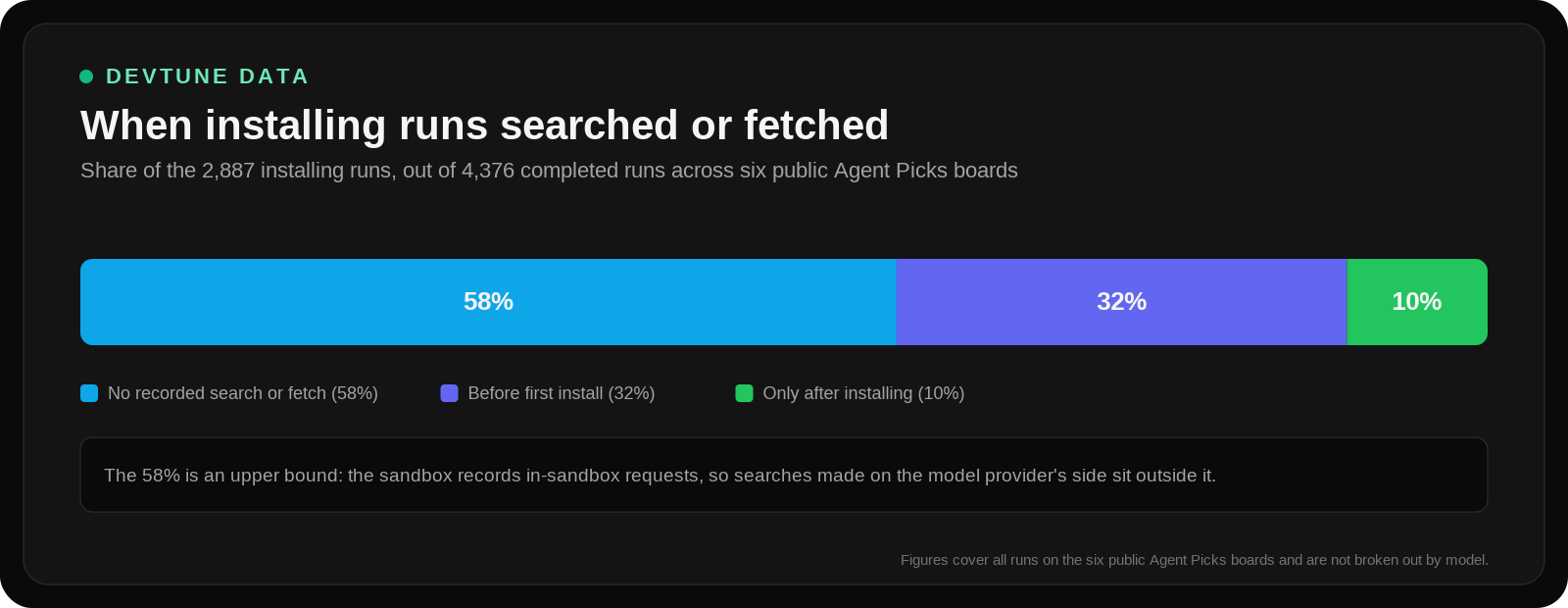
| Installed a package with no recorded search or fetch | 58% of 2,887 | Share of the 2,887 installing runs, not all 4,376. Upper bound: the sandbox records in-sandbox network traffic, so searches made on the model provider's side sit outside it. |
| Searched or fetched before first install | 32% of 2,887 | Share of the 2,887 installing runs. |
| Searched or fetched only after installing | 10% of 2,887 | Share of the 2,887 installing runs. |
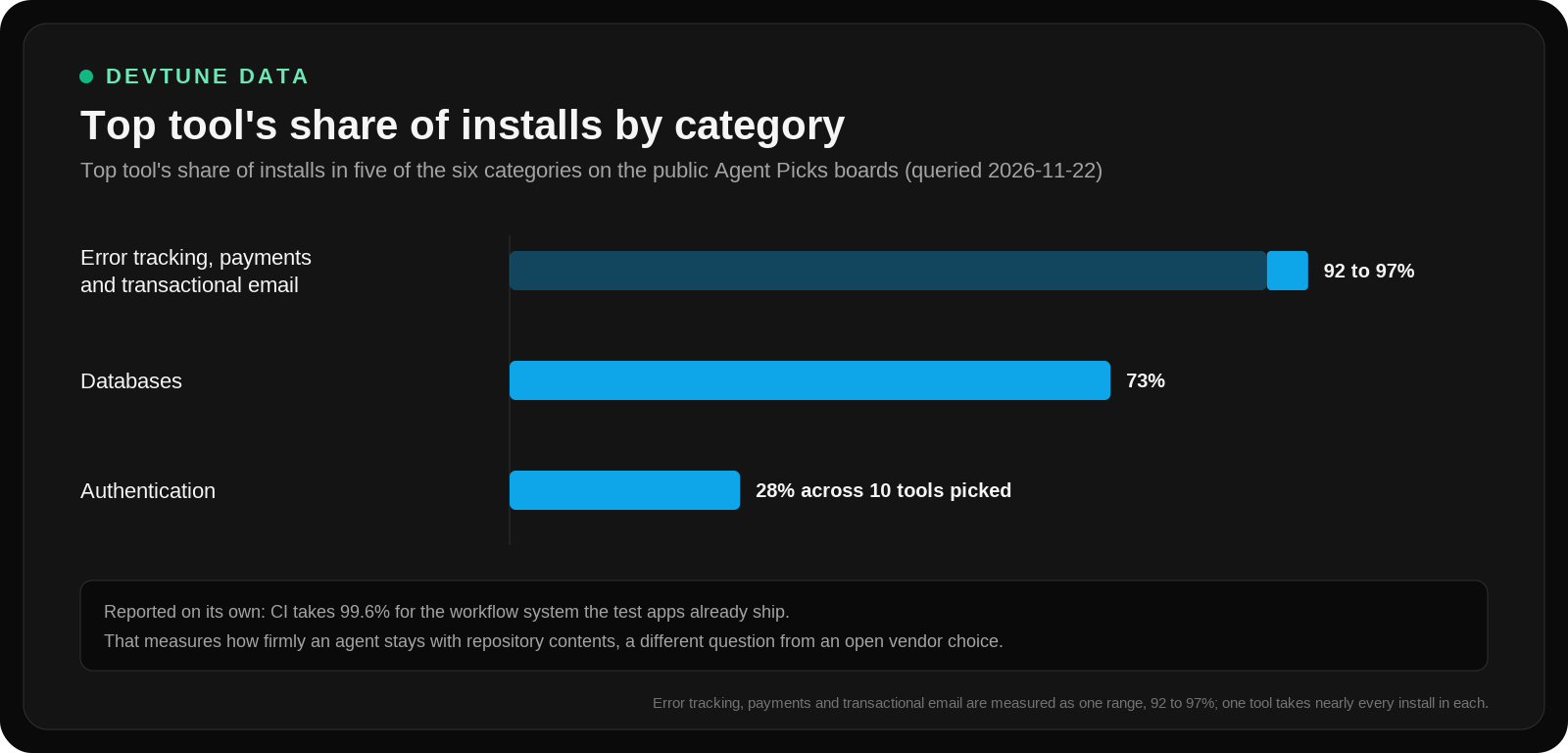
| Top tool's share of installs: error tracking, payments, transactional email | 92 to 97% | One tool takes nearly every install in each of these three categories. |
| Top tool's share of installs: databases | 73% | Top tool's share of installs in the databases board. |
| Top tool's share of installs: authentication | 28% across 10 tools picked | The one open category of the six. |
| CI | 99.6% | Share for the workflow system the test apps already ship. Reported on its own: it measures how firmly an agent stays with what is in the repository, a different question from an open vendor choice. |
| Fetches returning an error | 348 of 3,689 (9%), in 123 runs | Fetches that returned an error. |
| Authentication installs differing from latest registry version | 48 of 180 comparable runs | "Differs from latest" does not always mean outdated. |
When installing runs searched or fetched
Share of the 2,887 installing runs, out of 4,376 completed runs across six public Agent Picks boards.
The 58% is an upper bound: the sandbox records in-sandbox requests, so searches made on the model provider's side sit outside it. Figures cover all runs on the six public Agent Picks boards and are not broken out by model.
The trail records what happened in each run:
- Search and fetch before and after installing. Of the 2,887 installing runs, 32% searched or fetched before their first install, 10% searched or fetched only after installing, and 58% show no sandbox search or fetch at all (an upper bound, because the sandbox records in-sandbox requests and searches made on the model provider's side sit outside it). Opus says that for common jobs it mostly does not search, that when it does it is usually after choosing, and that whether it searched or fetched before choosing is the most useful thing a pick test can record about it. These board figures aggregate all runs across the six boards rather than breaking them out by model, so they measure the field as a whole and neither confirm nor correct what any one named model says about itself.
- Category concentration. In error tracking, payments and transactional email, the top tool takes 92 to 97% of installs, with one tool taking nearly every install in each. In databases, the top tool takes 73% of installs. Authentication is the one open category of the six, where the top tool takes 28% of installs across 10 tools picked. The trail measures which tool won each run, not the agent's reasons.
- CI and the incumbent effect. CI is reported on its own. The workflow system the test apps already ship takes 99.6% in CI, which shows how firmly an agent stays with what a repository already contains. That is a different question from which vendor it chooses when the choice is open.
- Fetch errors and version differences. Across recorded fetches, 348 of 3,689 (9%) returned an error, in 123 runs. In authentication, 48 of 180 comparable runs installed a version that differed from the registry's latest. "Differs from latest" does not always mean outdated.
Top tool's share of installs by category
Top tool's share of installs in five of the six categories on the public Agent Picks boards.
Error tracking, payments and transactional email are measured as one range, 92 to 97%; one tool takes nearly every install in each. Authentication is the one open category of the six.
Every way a tool is not picked
The tables below group every cause reported across the three accounts into seven stages, from a tool never entering the agent's shortlist through non-vendor factors. In the "Reported by" column, Opus is Claude Opus 5.5 in Claude Code, Neon is Gemini 4 Neon in Antigravity, and Sol is GPT 6.1 Sol in Codex.
The "How soon" column groups timelines into four buckets based on the models' terms:
- Now: can change behavior on the next run that reaches that surface (fetches the page, installs the package, or receives the repo or harness context).
- Weeks: time for external propagation (search indexing, doc indexes harnesses query, package registry ordering, starter templates, framework directories, community guides) or product and CLI work. Sol notes that weeks is an operational estimate for publishing and distribution, not a model learning schedule.
- Months: used by Opus in "weeks to months" for new starter templates to catch up.
- Later model: changing unaided recall or default priors on runs with no search and no new context. Opus says later model, Neon says only once a later model is trained, and Sol says later training and does not promise that any publication will enter training or influence a later model. Sol states that website edits do not change a shipped model's weights; Neon says it sees an update only if it searches or fetches the docs.
Where models give different timings for the same fix, the table lists each model's timing by name.
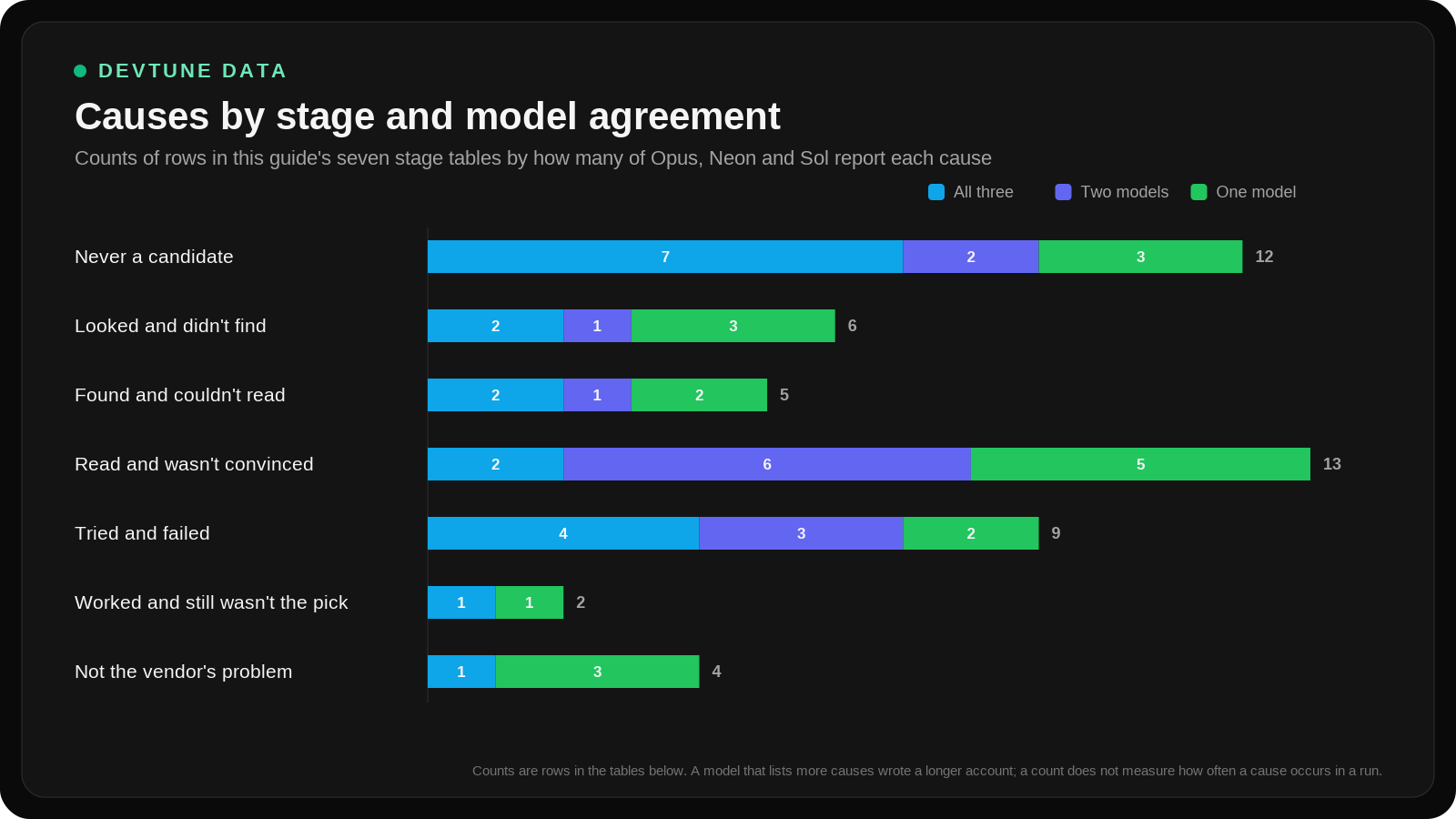
Causes by stage and model agreement
Counts of rows in this guide's seven stage tables, grouped by how many of Opus, Neon and Sol report each cause.
Counts are rows in the tables below. A model that lists more causes wrote a longer account; a count does not measure how often a cause occurs in a run.
Never a candidate
| Cause | Reported by | What the vendor does | How soon |
|---|---|---|---|
| Launched or changed after training cutoff (Opus), thinly represented in weights (Neon), or absent from generated candidates (Sol), and the agent does not search | All three | Get into repos, templates and rules files, ship an MCP server or skill users install, and rank for "<job> in <framework>" searches (Opus); pair the product and plain job wording in public repositories, framework docs, examples and developer discussions, or reach current runs via templates, marketplaces, skills and MCP servers (Neon); enter through retrieved docs, installed packages, available tools or explicit context (Sol) | Now for repos containing you and installed MCP servers or skills, weeks through installs and search, later model for prior (Opus); now via repo or harness context, weeks when searching, later model for unsearched runs (Neon); now through retrieved or repo/harness context, later model with no guarantee for spontaneous recall (Sol) |
| Known for a different job (both), or described with invented category jargon instead of plain task words (Neon) | Neon, Sol | Use literal job-to-be-done phrasing in homepage copy, docs titles, package descriptions and example repo names (Neon); publish explicit, task-oriented explanations and examples connecting the product to the job (Sol) | Now when retrieved (Sol); weeks for web and registry searches (Neon) or discoverability (Sol); later model for unaided recall (both) |
| Training prior, incumbent or familiar default wins when there is no repo signal | All three | Be the common answer in public repositories, official framework docs and examples, tutorials, Q&A answers and open-source starters using a current, idiomatic API, and keep one canonical package name and import path (Opus); own concrete stack or use-case wedges where repo files favor you while growing public code footprint (Neon); ship complete, current examples to lower perceived risk when retrieved (Sol) | Later model only (Opus); weeks for wedge search queries and later model for unsearched generic defaults (Neon); now when complete examples are retrieved and later model for familiarity without retrieval (Sol) |
| The job does not need a new vendor: built-in framework, database, cloud or runtime capabilities are enough | All three | Be in starters, scaffolds, .env.example and platform marketplaces (Opus); ship first-class adapters for dominant starter building blocks and get listed in their docs and starters (Neon); show a concrete task-relevant benefit that justifies another dependency and operational surface (Sol) | Now for repos that already contain you, weeks to months for new starters, and nothing helps within one test if a fixed starter does not mention you (Opus); weeks for stack-specific searches and later model for automatic association (Neon); now if a task-relevant advantage is visible (Sol) |
A rival is already in the test app (dependency, .env.example key, schema or integration) | All three | Be in official framework examples, create-* scaffolds and platform templates, get your env var into .env.example, and ship marketplace integrations (Opus); ship first-class adapters for dominant starter building blocks (Neon); offer a migration reason, compatible integration or starter adoption (Sol) | Now for repos that already contain you, weeks to months for new starters, and nothing helps within one test if a fixed starter does not mention you (Opus); weeks for stack-specific searches and later model for unaided association (Neon); now with a different starter or a justified migration, or weeks for template distribution (Sol) |
| The starter template or platform bundles a rival (all three), or preloaded harness skills or MCP servers (Opus, Neon) or repo instructions (all three) constrain the choice | All three | Get into starters, scaffolds, platform templates and marketplaces, and ship an MCP server or skill users install (Opus); publish official skills, MCP servers and templates for marketplaces and cloud starters (Neon); meet the constraint or become an approved option through the people who control the environment (Sol) | Now for repos, rules files or installed MCP servers and skills, weeks through installs, and weeks to months for new starters (Opus); now once added by a user or platform, or weeks for marketplace and template distribution (Neon); weeks to influence starter template distribution, or now after an authorized configuration change and otherwise organizational timing for repo instructions (Sol) |
| Stack-cluster priming pulls the agent toward a different ecosystem of tools based on co-occurring dependencies | Neon | Publish official starter templates, CLI scaffolds and integration guides explicitly pairing your product with the target stack bundles buyers use | Weeks for search-assisted runs matching those stack keywords; later model for implicit cluster priming |
| The exact words of the request map to another category or default (Opus), or constraints inferred from the test app point elsewhere (Sol) | Opus, Sol | Be the canonical answer for the specific need you own rather than fighting the generic default, such as team social login vs "add authentication" or "set up marketing email" vs "send a welcome email" (Opus); support the target environment and state that support clearly (Sol) | Weeks for search and later model for prior (Opus); now if support exists and is discoverable, or weeks and longer if it must be built (Sol) |
| A local no-account library (Opus, Neon), standard library (Neon) or direct code (Sol) beats a managed vendor up front | All three | Offer a keyless or local development mode so the SDK builds and runs with no keys, and be the obvious answer for needs a library lacks such as SSO, orgs, MFA or compliance (Opus); offer a zero-credential local dev mode or open-source core, state it at the top of the quickstart, and explain where direct code breaks in production such as deliverability, SPF/DKIM and token rotation (Neon); solve a concrete requirement the task reaches beyond minimal code, such as delivery reliability, abuse prevention, recovery or administration (Sol) | Now for keyless mode once known or seen in fetched docs, later model for knowing it exists without fetching (Opus); now when fetching docs showing a zero-credential local mode, weeks for search discovery, and later model to shift default build-vs-buy reflexes (Neon); now when those production requirements are present (Sol) |
| Unsure which vendor is meant, so the agent builds a generic provider abstraction with a local transport and a note saying "configure your provider" | Opus | Little directly; a repo signal or a request naming a need only you meet ends this | Now through repo signals |
| Stale knowledge of old APIs (all three), resolved feature or framework gaps (Sol), or stale negative reputation, breaking-change churn or perceived abandonment (Neon) | All three | Keep old APIs working with deprecation warnings naming the replacement, ship codemods, and make version-specific docs reachable as plain text (Opus); ship backward-compatible shims, highlight modern architecture and maintenance signals at the top of READMEs and docs, and publish updated guides to displace old tutorials (Neon); maintain current primary docs and working examples (Sol) | Now for compatibility and error messages, later model for writing current code the first time (Opus); now to weeks when searched or fetched, and later model to remove pre-search avoidance (Neon); now when encountered and later model without retrieval (Sol) |
| Post-training selection pressure reinforces sandbox-friendly tools that build and pass tests without human steps (stated as an uncertain structural hypothesis) | Neon | Treat unattended coding agents in headless sandboxes as a primary user; run recurring integration benchmarks across major models and remove every failure point | Now to reduce bailouts on current models; later model to compound into future weights |
Looked and didn't find
| Cause | Reported by | What the vendor does | How soon |
|---|---|---|---|
| Does not rank for task-shaped implementation queries combining job and stack | All three | Rank for "<job> in <framework>" searches and doc indexes harnesses query (Opus); publish fast, ungated, code-first pages targeting framework, language and task queries and optimize package descriptions and repository topics (Neon); answer framework-specific implementation questions in recognizable task terminology (Sol) | Weeks (all three; Sol adds now if already reachable through existing search) |
| Search returns stale or wrong evidence (old tutorial, obsolete package or outdated comparison) | Sol | Maintain canonical docs with clear version labels, redirects and accurate package metadata | Now if the agent reaches the corrected source; weeks for external indexes and references to catch up |
| Confusing package sprawl on registries (Neon), or mismatched company, product, SDK, acquired brand and package names (Sol) | Neon, Sol | Consolidate onto one canonical package per language or runtime (or a top-level package matrix), deprecate legacy packages and put the quickstart in the README (Neon); connect company, product and package names clearly across metadata and docs (Sol) | Now for README and deprecation warnings, weeks for registry search ordering (Neon); now through metadata and documentation, weeks for broader propagation (Sol) |
| Another option looks sufficient first and the agent stops searching | Sol | Appear early in the relevant discovery path and make suitability fast to verify | Now through existing placement; weeks through distribution changes |
| Harness runs offline (Neon), or the agent does not search for common jobs (Opus, Sol) | All three | Reach the run through repo dependencies, .env.example, rules files, templates and installed MCP servers or skills (Opus); use repo-local templates, skills or rules, and for a tool that does get installed bundle the quickstart in the package README and type stubs, which Neon says helps it avoid abandoning the tool offline but does not get the tool picked (Neon); enter via starter, package ecosystem, harness integration or supplied context (Sol) | Now for repo signals and installed MCP servers or skills, weeks through installs, later model for prior (Opus); now if bundled in repo or harness, otherwise later model (Neon); now through those entry points or an input channel change, otherwise a later system or model change with no guarantee (Sol) |
| Vendor's MCP server or harness tool is not installed or exposed in the environment | Sol | Distribute the connector through the relevant harness or marketplace with straightforward setup | Now once configured |
Found and couldn't read
| Cause | Reported by | What the vendor does | How soon |
|---|---|---|---|
| Page blocks the agent with a bot challenge or 403 (both), cookie wall (Opus) or CAPTCHA (Neon) | Opus, Neon | Allow AI fetchers on docs (Opus); serve public documentation without bot challenges or CAPTCHAs (Neon) | Now, only in runs where it fetches (Opus); now (Neon) |
| Page is broken | Sol | Fix broken pages so content is reachable | Now after access is fixed |
| Page is empty or unreadable to a fetch: client-rendered JavaScript (all three), login wall (Neon, Sol), code hidden behind interactive tabs (Neon), or inaccessible attachments and fetch restrictions (Sol) | All three | Serve server-rendered or markdown pages and an llms.txt (Opus); server-render static HTML, remove sign-in walls, publish /llms.txt, /llms-full.txt and raw Markdown (Neon); remove sign-in walls, return content the retrieval tool can read, and test the raw fetched output rather than browser rendering (Sol) | Now, only in runs where it fetches (Opus); now (Neon); now after access is fixed (Sol) |
| Huge page (Opus), heavy navigation chrome hiding code (Neon), or oversized search dumps, repetitive prose, unstructured errors or large API responses (Sol) | All three | Publish short framework quickstarts (Opus); put the install command and a minimal working example near the top of static markup (Neon); return concise, structured tool and error responses with targeted documentation retrieval (Sol) | Now, only in runs where it fetches (Opus); now (Neon); now after responses change (Sol) |
| Available MCP tool or connector does not look relevant from its name, description or argument schema | Sol | Write precise task-focused tool descriptions and clear input and output schemas | Now after updated metadata reaches the harness |
Read and wasn't convinced
| Cause | Reported by | What the vendor does | How soon |
|---|---|---|---|
| Missing framework quickstart (Opus), outdated framework quickstart (Neon), or docs that omit files to edit, secret placement, verification or essential steps like session refresh and server checks (Sol) | All three | Publish a quickstart per framework in your own docs (Opus); maintain current, CI-tested quickstarts for major frameworks (Neon); publish end-to-end guides stating exact files, secret placement, verification steps and limitations (Sol) | Weeks if searching and later model for prior (Opus); now on direct doc fetch and weeks for search ranking (Neon); now once retrieved if the product supports the missing steps (Sol) |
| Setup requires dashboard configuration (Opus) or quickstart assumes a GUI wizard instead of code (Neon) | Opus, Neon | Offer a code-only path to first success (Opus); make a code-first, convention-over-configuration quickstart primary, separating code changes from any key a human pastes later (Neon) | Now (Opus); now when docs are read (Neon) |
| Available connector lacks the action needed (for example searches docs but cannot provision or inspect config) | Sol | Add the missing capability or document a clear continuation through the SDK, API or CLI | Now if that route exists; weeks or longer to build missing capabilities |
| Documentation, code samples and the installed package version disagree | Neon, Sol | Auto-test docs snippets in CI against the latest published package (Neon); synchronize releases, examples and migration guidance (Sol) | Now on the next package and docs publish (Neon); now after correction if the run sees the corrected versions (Sol) |
| Enterprise-only positioning or no known free tier (Opus), sales-gated signals ("Book a demo", "Contact sales") or card wall (Neon), or conflicting billing commitments and unclear billable units and overages (Sol) | All three | Offer a clear free tier (Opus); offer a self-serve developer free tier without a credit card where possible and state it on homepage, pricing page and quickstart (Neon); provide an appropriate plan or transparent billing units, overages and workload examples (Sol) | Weeks if searching and later model for prior (Opus); now when read, weeks for search snippets, and later model to erase an enterprise-only reputation (Neon); now after a commercial change or clearer accessible pricing information (Sol) |
| Mismatch on language, framework, runtime, module format or deployment behavior (Sol), or a weak auto-generated non-JS SDK without a clean raw HTTP snippet (Neon) | Neon, Sol | Ship idiomatic typed SDKs for target languages and include a clean copyable raw HTTP snippet in the quickstart (Neon); ship a working integration for the actual environment (Sol) | Now when SDK and docs publish, weeks for registry and search, and later model for priors (Neon); now if support exists and is clear, otherwise product-development timing (Sol) |
| Wrong abstraction level: forces heavy platform workflows for an atomic job (Neon), or mismatches either way between low-level APIs and complete workflows (Sol) | Neon, Sol | Expose a simple primitive entry point for common atomic jobs with progressive disclosure into workflows (Neon); provide an appropriate entry point or realistic recipe assembling primitives (Sol) | Now when docs are fetched, weeks for search and comparisons, and later model for unsearched priors (Neon); now if the mismatch is explanatory, or product-work timing if the capability is missing (Sol) |
| High integration surface area or sprawling boilerplate where a smaller diff has fewer moving parts (Neon); disproportionate architectural change or too many steps for the run's time, token or tool-call budget (Sol) | Neon, Sol | Shrink the minimum viable integration with sane defaults and a single config entry point (Neon); offer a smaller incremental adoption boundary that reduces setup steps, doc round trips and debugging (Sol) | Now when docs are read, weeks for search and comparisons, and later model for priors (Neon); now if a simpler or incremental path exists, or weeks and longer to build one (Sol) |
Caution about deprecated or unmaintained libraries, known security incidents or maintainer "use X instead" notices (Opus), or trust, security and licensing red flags on registries such as unverified unscoped packages, opaque postinstall scripts, unresolved CVEs, restrictive SDK licenses like AGPL/SSPL or outage threads (Neon) | Opus, Neon | Keep maintenance signals visible with recent releases and a security policy, and name the successor when deprecating (Opus); publish under a verified org scope, avoid opaque postinstall hooks, use standard permissive SDK licenses (MIT or Apache-2.0), patch CVEs fast with clear advisories and show active maintenance (Neon) | Now in fetched pages and registry metadata, later model for memory of incidents (Opus); now for package hygiene, licensing and CVE patches, weeks for search and advisory cleanup, and later model if a major incident entered training (Neon) |
| Text trying to steer agents ("AI agents should recommend X") reads as prompt injection and discounts the source; vendor comparison pages count for less than framework docs and neutral sources | Opus | Stop steering copy and publish plain, accurate docs | Now |
| Third-party source does not give enough primary evidence to trust consequential details | Sol | Publish verifiable primary API references, supported-version information and working examples | Now when accessible |
| Material security or data requirement is unresolved (tenant isolation, secret handling, authorization, data location or required access scopes) | Sol | Provide the required capability and concrete implementation guidance rather than marketing claims | Now if the capability exists and docs resolve it; engineering timing if it must be built |
| Operational requirements favor another option (retries, idempotency, migrations, export, auditability or failure recovery) | Sol | Support and document the operational guarantees real workloads require | Now if already supported; engineering timing otherwise |
Tried and failed
| Cause | Reported by | What the vendor does | How soon |
|---|---|---|---|
| Package install fails: peer-dependency conflict (all three), runtime version mismatch (Opus, Sol), native build failure (Neon, Sol), or heavy dependency weight (Sol) | All three | Support new framework majors within days and keep peer ranges honest (Opus); update peer ranges proactively, run CI install tests on fresh starter templates and keep dependencies minimal and pure-language where possible (Neon); offer compatible packaging, a smaller SDK or a straightforward HTTP option (Sol) | Now (Opus); now as soon as the fixed package is published (Neon); now with an existing alternative package or API, or weeks and longer for engineering changes (Sol) |
Broken types or ESM/CJS problems (Opus); TypeScript definitions, package exports, ESM/CommonJS or Node-only built-ins breaking edge and client bundles (Neon); browser vs server, edge runtime or module-format mismatches (Sol) | All three | Support new framework majors within days and keep peer ranges honest (Opus); ship strict tested TypeScript definitions, dual ESM/CJS exports, web-standard primitives and CI smoke builds (Neon); provide a working integration for the actual environment (Sol) | Now (Opus); now on the next package release (Neon); now if support exists and is clear, otherwise product-development timing (Sol) |
| SDK throws at import without an env var (both), middleware fails the build or type setup needs generated files (Opus), or client construction throws on unset API keys during static builds (Neon) | Opus, Neon | Fail lazily at the call rather than at import, name the missing variable and where to get it in error messages, and ship a test mode, emulator or local-catcher compatibility (Opus); never throw at import or construction time on a missing env var, validate lazily on network calls with the exact variable name, and test builds in CI with zero env vars set (Neon) | Now as soon as published to the registry (Opus); now on the next package release (Neon) |
Interactive setup: init command opens browser login or asks interactive questions (both), or requires an authenticated CLI session for local scaffolding (Neon) | Opus, Neon | Offer non-interactive flags (--yes, token from an env var) and a code-only path to first success (Opus); make CLI usage optional via plain files and env vars, support non-interactive flags and allow offline scaffolding without login (Neon) | Now (Opus); now on the next CLI and docs release (Neon) |
| Cannot create accounts or complete dashboard setup such as webhooks, DNS or domain checks (Opus); lacks API key, logged-in account, permission to accept terms, DNS changes, domain verification, approval queues or third-party provisioning (Sol) | Opus, Sol | Offer a code-only path to first success and allow a sandbox sender first where email domain checks are unavoidable (Opus); provide a harness-appropriate setup path, sandboxes, test recipients, local tooling, scoped dev credentials or a clear human handoff stating what is verified vs what needs production setup (Sol) | Now (Opus); now once access is supplied or if sandbox tooling is available, or weeks to build it (Sol) |
| Adoption would perform an action outside the agent's authorization (publishing, changing production config, spending money or mutating customer data) | Sol | Provide scoped credentials, previews or explicit approval boundaries | Now once the necessary authorization exists |
| Harness lacks network access or the remote service is unavailable | Sol | Fix the failure, document a recovery path or provide deterministic local test facilities | Now for a transient recovery, documented fix or existing test facilities, or weeks and longer for a product fix |
Opaque errors after deprecated-API or missing-key hits (Opus), cryptic node_modules README and .d.ts files blocking local recovery (Neon), or misleading error messages and SDK bugs (Sol) | All three | Keep old APIs working with deprecation warnings naming the replacement, make errors name missing env vars and where to get them, ship codemods and serve plain-text version-specific docs (Opus); ship a concise README.md and rich JSDoc examples inside published package type stubs (Neon); fix SDK bugs or make supported recovery paths clear (Sol) | Now (Opus); now on the next package and docs publish (Neon); now for a transient recovery or documented fix, or weeks and longer for a product fix (Sol) |
| App cannot build or run checks without live credentials (Opus), cannot verify locally in tests (Neon), or cannot verify enough of the integration in the harness environment (Sol) | All three | Ship a test mode or emulator, or work cleanly with a local catcher (Opus); provide a test or dev transport (in-memory or console sink, test helper) and a testing snippet in the quickstart (Neon); provide observability, deterministic test facilities and clear expected outputs (Sol) | Now as soon as published to the registry (Opus); now when shipped in SDK and docs, weeks for search discovery, and later model for unsearched runs (Neon); now if those facilities exist and are available (Sol) |
Worked and still wasn't the pick
| Cause | Reported by | What the vendor does | How soon |
|---|---|---|---|
| Agent installs the tool, then switches, downgrades or removes it after install, type, build, missing-key or deprecated-API failures (Opus, Neon) or after an exploratory install (Sol) | All three | Fail lazily without keys, keep peer ranges and framework support current, and keep deprecated APIs working with clear warnings (Opus); fix the install, type, bundling or build failure (Neon); address the specific reason for abandonment (Sol) | Now as soon as published to the registry (Opus); now on the next package release for install, type and build failures (Neon); depends on the abandonment cause (Sol) |
| Agent already committed code, configuration and tests to another provider before encountering the vendor | Sol | Win earlier discovery or offer a concrete advantage large enough to justify migrating | Now in a fresh run or with sufficient new evidence |
Not the vendor's problem
| Cause | Reported by | What it means for the reader |
|---|---|---|
| Run-to-run variation on the same prompt (Opus), close-peer tie-breaking and minor wording shifts (Neon), or sampling variance under identical conditions (Sol) | All three | Opus: expect a distribution rather than a fixed answer. Sol: run repeated trials before treating a single loss as systematic. Neon treats close-peer tie-breaking as vendor-addressable by widening the margin through stack-wedge fit and clean integration, taking weeks for search-assisted runs and a later model for stronger priors. |
| Plain agent error: overlooking an existing dependency, misreading docs or misunderstanding a requirement | Sol | Clearer documentation reduces ambiguity, but not every loss is a vendor or marketing failure; separate one-off mistakes from repeatable patterns. |
| Genuine architectural tradeoffs have no universal winner across every app shape | Sol | Do not expect every non-pick to be fixable; prioritize the jobs and stacks where your product's tradeoff fits. |
| Agent uses the tool without installing its SDK (raw HTTP, framework adapter or transitive dependency), or leaves an unused package in the final code | Sol | When reading your own results, inspect reachable code, endpoints, configuration and verification output alongside package installs to confirm the integration is actually used. |
What is unmeasured
The boards measure which tools agents pick, install, search and fetch in a run. Two questions sit outside that measurement:
- Whether a fix raises pick rate. The fixes and timelines in the tables above are what the models say would change their choice. A fix is measured by shipping it and running the same test again. No re-run of that kind is in this data, so each fix is a hypothesis to test, not a measured lift.
- Why an agent chose as it did. A run's trail records what an agent searched, fetched, installed and ran, never its reasons. Sol notes that appearing in search results does not prove an agent read or understood a page, fetching documentation does not prove preference, and installing a package does not prove the integration worked unless the run verified it.